Each of the five verses ends “to him who is the syllable …”, taking in turn न म शि वा य: read down the verses and you spell नमः शिवाय, the five-syllable mantra from the Śrī Rudram (Taittirīya Saṃhitā 4.5.8).
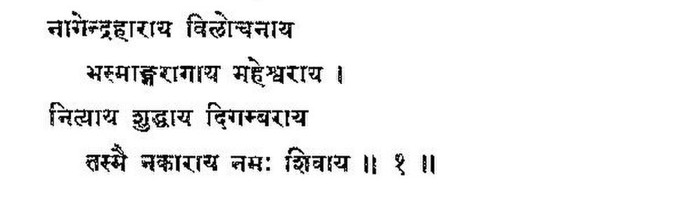
Salutation to Śiva, who is the syllable na: who wears the king of serpents as a garland, of the wondrous eyes (sung today as trilocanāya, “the three-eyed”), whose body is dusted with sacred ash, the great lord; eternal, pure, clothed only by the directions.
ज्यांच्या गळ्यात सर्पराजाचा हार आहे, ज्यांचे डोळे विलक्षण आहेत (आज ‘त्रिलोचनाय’ म्हणजे तीन डोळ्यांचे, असे म्हटले जाते), भस्म हाच ज्यांचा अंगलेप आहे, जे महेश्वर आहेत; जे नित्य, शुद्ध आणि दिगंबर आहेत, त्या ‘न’काररूप शिवाला नमस्कार.
जिनके कंठ में सर्पराज का हार है, जिनके नेत्र विलक्षण हैं (आज ‘त्रिलोचनाय’ यानी त्रिनेत्र गाया जाता है), भस्म ही जिनका अंगराग है, जो महेश्वर हैं; जो नित्य, शुद्ध और दिगम्बर हैं, उन ‘न’कार-स्वरूप शिव को नमस्कार।
1910 च्या पुस्तकात हेच कडवं · पान 119Works of Sri Sankaracharya, vol. 17 (Stotras, part 1), 1910, pp. 119–120 (scan pp. 131–132)
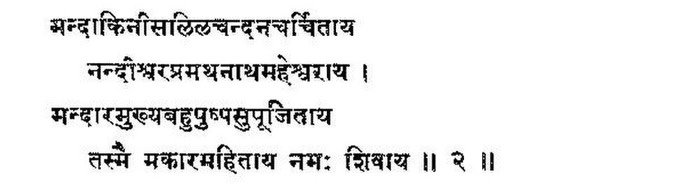
Salutation to Śiva, who is the syllable ma: anointed with the waters of the Mandākinī and with sandal paste, the great lord who rules Nandī and the pramatha hosts, worshipped with mandāra and countless other flowers.
जे मंदाकिनीच्या पाण्याने आणि चंदनाने चर्चित आहेत, जे नंदीश्वर आणि प्रमथगणांचे स्वामी महेश्वर आहेत, ज्यांची मंदार आणि इतर अनेक फुलांनी पूजा होते, त्या ‘म’काररूप शिवाला नमस्कार.
जो मंदाकिनी के जल और चंदन से चर्चित हैं, नंदीश्वर और प्रमथगणों के स्वामी महेश्वर हैं, मंदार और अनेक पुष्पों से पूजित हैं, उन ‘म’कार-स्वरूप शिव को नमस्कार।
Verse 2 is in a different metre from the rest (vasantatilakā, 14 syllables a line). In the 1910 print all four lines scan; the popular shortened refrain does not.
1910 च्या पुस्तकात हेच कडवं · पान 119Works of Sri Sankaracharya, vol. 17 (Stotras, part 1), 1910, pp. 119–120 (scan pp. 131–132)
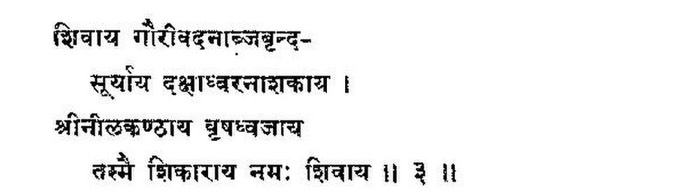
Salutation to Śiva, who is the syllable śi: the auspicious one, a sun to the cluster of lotuses that is Gaurī’s face, destroyer of Dakṣa’s sacrifice, the blue-throated one whose banner bears the bull.
जे कल्याणरूप आहेत, गौरीच्या मुखकमलांना फुलवणारे सूर्य आहेत, दक्षाच्या यज्ञाचा नाश करणारे आहेत, जे श्री नीलकंठ आहेत आणि ज्यांच्या ध्वजावर वृषभ आहे, त्या ‘शि’काररूप शिवाला नमस्कार.
जो कल्याणस्वरूप हैं, गौरी के मुखकमलों को खिलाने वाले सूर्य हैं, दक्ष के यज्ञ का नाश करने वाले हैं, जो श्री नीलकंठ हैं और जिनकी ध्वजा पर वृषभ है, उन ‘शि’कार-स्वरूप शिव को नमस्कार।
1910 च्या पुस्तकात हेच कडवं · पान 119Works of Sri Sankaracharya, vol. 17 (Stotras, part 1), 1910, pp. 119–120 (scan pp. 131–132)
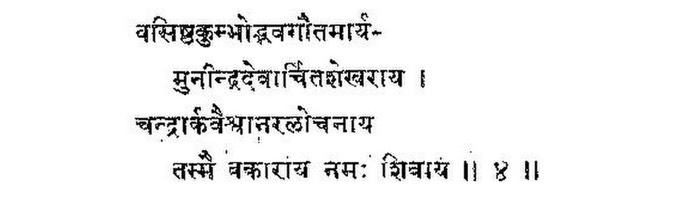
Salutation to Śiva, who is the syllable va: whose crown is worshipped by Vasiṣṭha, Agastya, Gautama and the greatest sages and gods, whose eyes are the moon, the sun and fire.
वसिष्ठ, अगस्त्य, गौतम अशा श्रेष्ठ मुनींनी आणि देवांनी ज्यांच्या मस्तकाची पूजा केली आहे, चंद्र, सूर्य आणि अग्नी हे ज्यांचे डोळे आहेत, त्या ‘व’काररूप शिवाला नमस्कार.
वसिष्ठ, अगस्त्य, गौतम आदि श्रेष्ठ मुनियों और देवताओं ने जिनके मस्तक की पूजा की है, चंद्र, सूर्य और अग्नि जिनके नेत्र हैं, उन ‘व’कार-स्वरूप शिव को नमस्कार।
The margin shows वा as in नमः शिवाय. The verse says वकाराय with a short va, because the metre needs a short syllable there.
1910 च्या पुस्तकात हेच कडवं · पान 120Works of Sri Sankaracharya, vol. 17 (Stotras, part 1), 1910, pp. 119–120 (scan pp. 131–132)
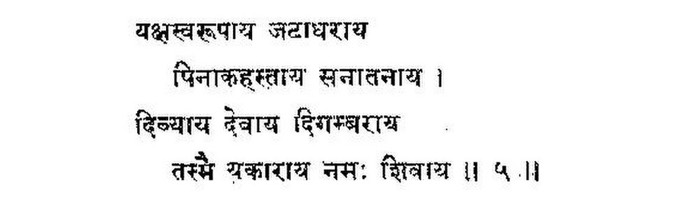
Salutation to Śiva, who is the syllable ya: who takes the form of the yakṣa (many texts read “whose form is the sacrifice”), who wears matted locks and holds the bow Pināka, the everlasting, the shining god, clothed only by the directions.
जे यक्षाचे रूप धारण करतात (अनेक पाठांत: यज्ञस्वरूप), जे जटाधारी आहेत, ज्यांच्या हातात पिनाक धनुष्य आहे, जे सनातन आहेत, जे दिव्य देव आणि दिगंबर आहेत, त्या ‘य’काररूप शिवाला नमस्कार.
जो यक्ष-रूप धारण करते हैं (कई पाठों में: यज्ञस्वरूप), जटाधारी हैं, हाथ में पिनाक धनुष रखते हैं, सनातन हैं, जो दिव्य देव और दिगम्बर हैं, उन ‘य’कार-स्वरूप शिव को नमस्कार।
1910 च्या पुस्तकात हेच कडवं · पान 120Works of Sri Sankaracharya, vol. 17 (Stotras, part 1), 1910, pp. 119–120 (scan pp. 131–132)
commonly sung today (popular online texts; to cite a print) The 1910 print reads विलोचनाय, and only that reading fits the metre: with त्रि- the sixth syllable turns long and the indravajrā line breaks.
2.3
मन्दारमुख्यबहुपुष्पसुपूजिताय
मन्दारपुष्पबहुपुष्पसुपूजिताय worshipped with mandāra and many other flowers
commonly sung today (popular online texts; to cite a print) We follow the 1910 print.
2.4
मकारमहिताय
मकाराय who is the syllable ma
commonly sung today (popular online texts; to cite a print) With मकारमहिताय all four lines of verse 2 are vasantatilakā (14 syllables). The shorter मकाराय copies the refrain of the other verses and breaks this verse's metre.
3.1
गौरीवदनाब्जबृन्द-
गौरीवदनाब्जवृन्द- spelling only (ब/व), same word (spelling)
commonly sung today (popular online texts; to cite a print) We keep the print's spelling.
5.1
यक्षस्वरूपाय
यज्ञस्वरूपाय whose form is the sacrifice
many popular texts (to cite) The 1910 print reads यक्षस्वरूपाय.
कोणी लिहिला, आणि आम्हांला किती खात्री आहेĀdi Śaṅkarācārya, by tradition
By tradition, Ādi Śaṅkarācārya: the 1910 print’s colophon names him; the hymn itself does not.
The 1910 print ends with a colophon naming Śaṅkara (इति श्रीमत्परमहंसपरिव्राजकाचार्यस्य … श्रीमच्छंकरभगवतः कृतौ). (W1 p. 120)
The hymn itself does not name its author, and no study testing it was found. (search 25 Nov 2026)
हा पाठ कुठून आला
Each of the five verses ends “to him who is the syllable …”, taking in turn न म शि वा य: read down the verses and you spell नमः शिवाय, the five-syllable mantra from the Śrī Rudram (Taittirīya Saṃhitā 4.5.8).
प्रचलित रूपे
The 1910 print differs from what most people sing in four places: विलोचनाय for त्रिलोचनाय, मन्दारमुख्य… in verse 2, the refrain तस्मै मकारमहिताय in verse 2, and no closing verse. In each place the print’s reading fits the metre and the popular one does not, which suggests the popular text was smoothed over time. Switch “As commonly sung” to read the familiar version.
केव्हा म्हणतात
Recited daily by Śiva devotees, on Mondays, in Śrāvaṇa and on Mahāśivarātri. The closing verse promises Śiva’s world to whoever recites it near Śiva.
Pramāṇa (prototype): Text re-keyed to the 1910 print and read against the page scans; popular readings recorded as variants; metre checked by program (engine-v2 phonology).
Sanskrit reviewer: Second print to compare; reviewer sign-off.
Pramāṇa content agent (AI): Marathi meanings (mr) drafted by AI in our own words, translated from our English and Hindi meanings, which follow the printed reading. Editor review pending.
Pramāṇa content agent (AI): Marathi word-by-word glosses (mr) drafted by AI, translated from our English and Hindi glosses, which follow the printed reading. Editor review pending.
प्रत्येक शब्दाचा अर्थ, संपूर्ण पाठ
Verse 1
नागेन्द्रहाराय
nāga-indra-hārāyawearing the king of serpents as a garland · सर्पराजाचा हार घालणारे
विलोचनाय
vi-locanāyato him of the wondrous eyes · विलक्षण डोळ्यांचे
भस्माङ्गरागाय
bhasma-aṅga-rāgāyawhose body is dusted with sacred ash · अंगाला भस्म लावणारे
महेश्वराय
mahā-īśvarāyathe great lord · महेश्वर
नित्याय
nityāyaeternal · नित्य
शुद्धाय
śuddhāyapure · शुद्ध
दिगम्बराय
dik-ambarāyasky-clad, clothed only by the directions · दिशा हेच ज्यांचे वस्त्र आहे असे
तस्मै
tasmaito him · त्यांना
नकाराय
na-kārāyawho is the syllable na · ‘न’ अक्षररूप
नमः
namaḥsalutation · नमस्कार
शिवाय
śivāyato Śiva · शिवाला
Verse 2
मन्दाकिनीसलिलचन्दनचर्चिताय
mandākinī-salila-candana-carcitāyaanointed with the waters of the Mandākinī and with sandal paste · मंदाकिनीचे जल आणि चंदन यांनी चर्चिलेले
नन्दीश्वरप्रमथनाथमहेश्वराय
nandīśvara-pramatha-nātha-mahā-īśvarāyathe great lord, master of Nandī and the pramatha hosts · नंदीश्वर आणि प्रमथगणांचे स्वामी महेश्वर
मन्दारमुख्यबहुपुष्पसुपूजिताय
mandāra-mukhya-bahu-puṣpa-su-pūjitāyaworshipped with many flowers, mandāra the first among them · मंदार आदी अनेक फुलांनी पूजलेले
तस्मै
tasmaito him · त्यांना
मकारमहिताय
ma-kāra-mahitāyahonoured as the syllable ma · ‘म’काररूपाने पूजलेले
नमः
namaḥsalutation · नमस्कार
शिवाय
śivāyato Śiva · शिवाला
Verse 3
शिवाय
śivāyathe auspicious one · कल्याणरूप
गौरीवदनाब्जबृन्द-
gaurī-vadana-abja-vṛnda-(a sun) to the cluster of lotuses that is Gaurī’s face · गौरीच्या मुखकमलांच्या समूहाला (फुलवणारे)
सूर्याय
sūryāyathe sun that makes them bloom · सूर्य
दक्षाध्वरनाशकाय
dakṣa-adhvara-nāśakāyadestroyer of Dakṣa’s sacrifice · दक्षाच्या यज्ञाचा नाश करणारे
श्रीनीलकण्ठाय
śrī-nīla-kaṇṭhāyathe revered blue-throated one · श्री नीलकंठ
वृषध्वजाय
vṛṣa-dhvajāyawhose banner bears the bull · ज्यांच्या ध्वजावर बैल (नंदी) आहे
तस्मै
tasmaito him · त्यांना
शिकाराय
śi-kārāyawho is the syllable śi · ‘शि’ अक्षररूप
नमः
namaḥsalutation · नमस्कार
शिवाय
śivāyato Śiva · शिवाला
Verse 4
वसिष्ठकुम्भोद्भवगौतमार्य-
vasiṣṭha-kumbha-udbhava-gautama-ārya-by Vasiṣṭha, pot-born Agastya, Gautama and other noble… · वसिष्ठ, कुंभज (अगस्त्य), गौतम आदी श्रेष्ठ…
मुनीन्द्रदेवार्चितशेखराय
muni-indra-deva-arcita-śekharāya…sages and by the gods, whose crown is worshipped · …मुनी आणि देव ज्यांच्या मस्तकाची पूजा करतात
चन्द्रार्कवैश्वानरलोचनाय
candra-arka-vaiśvānara-locanāyawhose eyes are the moon, the sun and fire · चंद्र, सूर्य आणि अग्नी हे ज्यांचे डोळे आहेत
तस्मै
tasmaito him · त्यांना
वकाराय
va-kārāyawho is the syllable va · ‘व’ अक्षररूप
नमः
namaḥsalutation · नमस्कार
शिवाय
śivāyato Śiva · शिवाला
Verse 5
यक्षस्वरूपाय
yakṣa-svarūpāyawho takes the form of a yakṣa, a wondrous being (some read this as the yakṣa of the Kena Upaniṣad) · यक्षाचे रूप घेणारे
जटाधराय
jaṭā-dharāyawearing matted locks · जटाधारी
पिनाकहस्ताय
pināka-hastāyaholding the bow Pināka · हातात पिनाक धनुष्य धरणारे
सनातनाय
sanātanāyaeverlasting · सनातन
दिव्याय
divyāyadivine · दिव्य
देवाय
devāyathe god · देव
दिगम्बराय
dik-ambarāyasky-clad, clothed only by the directions · दिगंबर
तस्मै
tasmaito him · त्यांना
यकाराय
ya-kārāyawho is the syllable ya · ‘य’ अक्षररूप
नमः
namaḥsalutation · नमस्कार
शिवाय
śivāyato Śiva · शिवाला
Verse phala
पञ्चाक्षरमिदं
pañca-akṣaram idamthis five-syllable hymn · हे पंचाक्षर स्तोत्र
पुण्यं
puṇyamsacred · पुण्य देणारे
यः
yaḥwhoever · जो
पठेच्छिवसन्निधौ
paṭhet śiva-sannidhaurecites near Śiva · शिवाच्या सान्निध्यात पठण करतो
शिवलोकमवाप्नोति
śiva-lokam avāpnotireaches the world of Śiva · शिवलोकाला पोहोचतो