
विष्णु · सूक्त

विष्णु · सूक्त

नारायणसूक्तम्

Narayana Sukta · Nārāyaṇasūktam

The thirteenth anuvāka of the Nārāyaṇa Upaniṣad, which is the tenth and last prapāṭhaka of the Taittirīya Āraṇyaka of the Black Yajurveda (numbering of our 1927 Poona print.

12 श्लोक

13 कडवेपट्टीला स्पर्श करून पुढे जा

सहस्रशीर्षं देवं विश्वाक्षं विश्वशंभुवम्विश्वं नारायणं देवमक्षरं परमं पदम् ॥ 1 ॥

The god with a thousand heads, eyes everywhere, from whom good comes to all; Nārāyaṇa, who is the All, the imperishable god, the highest goal (on him one should meditate).

सहस्र मस्तकांचा, सर्वत्र डोळे असलेला, सर्वांना सुख देणारा देव; जो स्वतः विश्व आहे, तो अविनाशी देव नारायण, परम पद (त्याचे ध्यान करावे).

सहस्र सिरों वाले, सब ओर नेत्रों वाले, सबको सुख देने वाले देव; जो स्वयं विश्व हैं, उन अविनाशी देव नारायण का, परम पद का (ध्यान करें)।

Sāyaṇa in W1 (p. 831) supplies ‘one should meditate on’ (ध्यायेत्) and says this god is the Lord (महेश्वर) named at the end of the previous anuvāka as dwelling in the lotus of the heart. ‘Thousand heads’ means countless: every head is his, since the whole world is his body. He explains ‘Nārāyaṇa’ by the verse आपो नारा इति प्रोक्ताः: the waters are called nārāḥ.

विश्वतः परमान्नित्यं विश्वं नारायणꣳ हरिम्विश्वमेवेदं पुरुषस्तद्विश्वमुपजीवति ॥ 2 ॥

Higher than the world, eternal, the All, Nārāyaṇa, Hari. This whole world is the Person himself, and he lives on that world.

तो जगाहून श्रेष्ठ, नित्य, विश्वरूप, नारायण, हरी आहे. हे सारे विश्व पुरुषच आहे, आणि तो पुरुष त्याच विश्वाच्या आधारे आपला व्यवहार करतो.

वे जगत् से श्रेष्ठ हैं, नित्य हैं, विश्व-रूप हैं, नारायण हैं, हरि हैं। यह सारा विश्व पुरुष ही है, और वे पुरुष उसी विश्व के सहारे अपना व्यवहार करते हैं।

Sāyaṇa in W1 (pp. 831–832): ‘beyond the world’ means beyond the mass of unconscious things; what we now see as the world, seen truly, is the Person, the highest Self, and he takes up the world for his own dealings. W2's commentary (p. 823) explains Hari as ‘the one who takes away sin and ignorance’.

पतिं विश्वस्याऽऽत्मेश्वरꣳ शाश्वतꣳ शिवमच्युतम्नारायणं महाज्ञेयं विश्वात्मानं परायणम् ॥ 3 ॥

Protector of the world, ruler of all selves, everlasting, auspicious, never falling: Nārāyaṇa, the greatest thing to be known, the self of all, the final refuge.

तो जगाचा पालक, सर्व आत्म्यांचा स्वामी, शाश्वत, मंगलमय, अच्युत आहे. तो नारायण जाणण्याजोग्यांत सर्वश्रेष्ठ, सर्वांचा आत्मा, परम आधार आहे.

वे जगत् के पालक हैं, सब आत्माओं के स्वामी हैं, शाश्वत हैं, मंगलमय हैं, अच्युत हैं। वे नारायण जानने योग्य वस्तुओं में सबसे महान् हैं, सबके आत्मा हैं, परम आश्रय हैं।

Sāyaṇa in W1 (p. 832): ‘self of all’ because he is the material cause of the world and not different from it; ‘final refuge’ because the whole imagined world rests on him as its ground.

नारायण परो ज्योतिरात्मा नारायणः परःनारायण परं ब्रह्मतत्त्वं नारायणः परःनारायण परो ध्याता ध्यानं नारायणः परः ॥ 4 ॥

Nārāyaṇa is the highest light; the Self, Nārāyaṇa, is the highest. Nārāyaṇa is the highest truth of Brahman; Nārāyaṇa is the highest. Nārāyaṇa is the highest meditator, and the meditation; Nārāyaṇa is the highest.

नारायण ही परम ज्योती; आत्मा नारायण परम आहे. नारायण हेच परम ब्रह्मतत्त्व; नारायण परम आहे. नारायण हाच परम ध्यान करणारा आणि ध्यानही; नारायण परम आहे.

नारायण परम ज्योति हैं; आत्मा नारायण परम हैं। नारायण परम ब्रह्म-तत्त्व हैं; नारायण परम हैं। नारायण ही परम ध्यान करने वाले हैं और ध्यान भी; नारायण परम हैं।

Sāyaṇa in W1 (p. 832): the Lord whom the Purāṇas call Nārāyaṇa is the truth of Brahman taught as ‘truth, knowledge…’; he is the Self, not some particular form; ‘highest light’ is the light the Chāndogya speaks of. He reads ‘the meditator’ as the seeker fit for Vedānta and ‘meditation’ as the turning of the mind to the inner Self. W1 prints a ॥ after the second line. W2 prints the third line's first word joined as नारायणपरो (p. 824); not counted as a difference.

यच्च किंचिज्जगत्सर्वं दृश्यते श्रूयतेऽपि वाअन्तर्बहिश्च तत्सर्वं व्याप्य नारायणः स्थितः ॥ 5 ॥

Whatever there is in the world, seen (close by) or heard of (far away): all of it Nārāyaṇa pervades, inside and outside, and so he stands.

या जगात जे काही (जवळचे) दिसते किंवा (दूरचे) ऐकिवात येते, त्या सर्वाला आतून आणि बाहेरून व्यापून नारायण स्थित आहे.

इस जगत् में जो कुछ भी (पास का) दिखाई देता है या (दूर का) सुना जाता है, उस सबको भीतर और बाहर से व्याप्त करके नारायण स्थित हैं।

Sāyaṇa in W1 (pp. 832–833): ‘seen’ is what is near, ‘heard of’ is what is far; Nārāyaṇa pervades it all as gold pervades the bracelets and crowns made of it. Both prints set the first block mark here: W1 (१), W2 ॥ १ ॥.

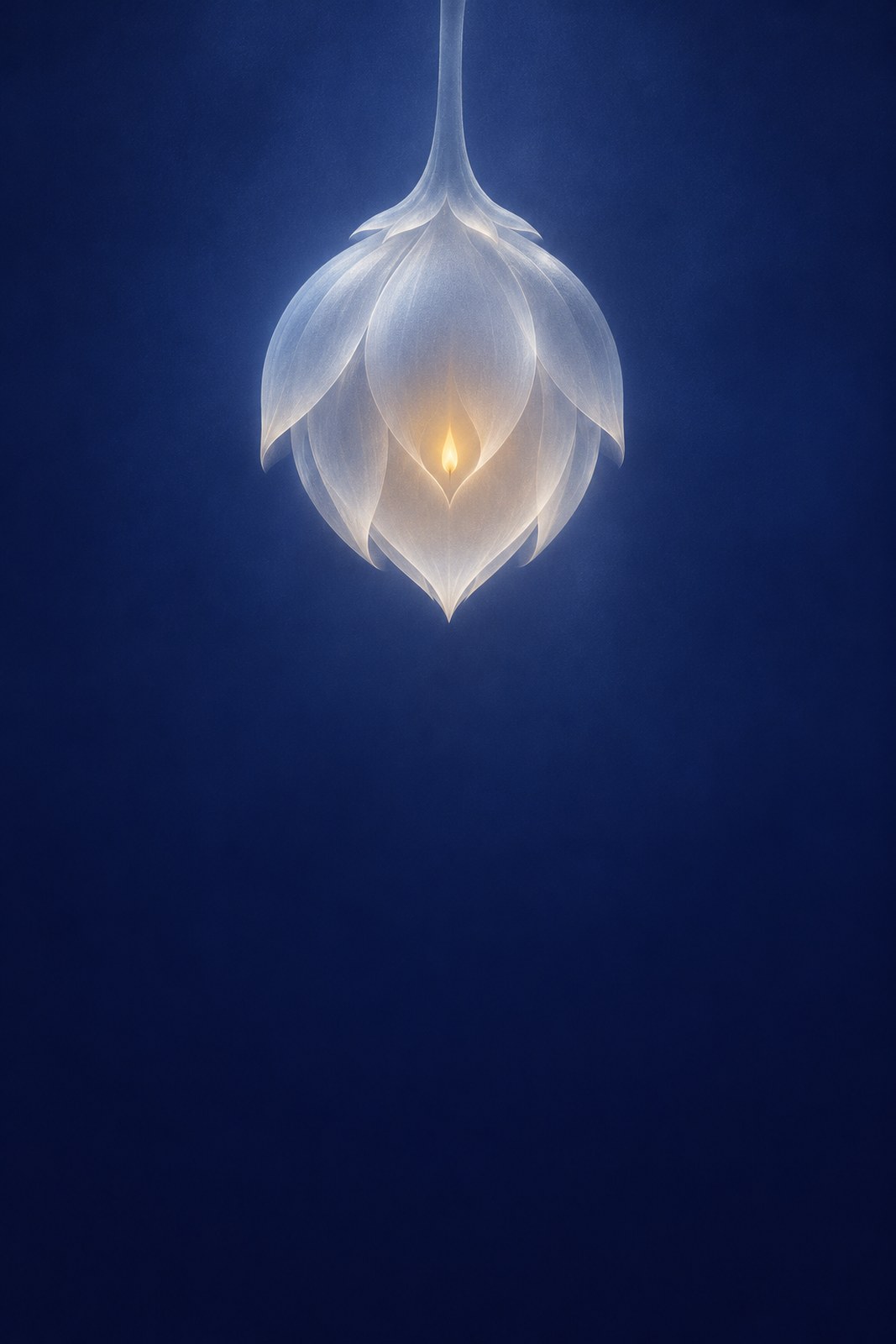
A downward-hanging lotus bud with a small flame inside.
श्लोक ६
अनन्तमव्ययं कविꣳ समुद्रेऽन्तं विश्वशंभुवम्पद्मकोशप्रतीकाशꣳ हृदयं चाप्यधोमुखम् ॥ 6 ॥

Endless, undecaying, all-knowing, the end of the ocean of worldly life, the one from whom good comes to all (is he). The heart is like a lotus bud, and it faces downward.

तो अनंत, अव्यय, सर्वज्ञ, संसार-सागराचा अंत, सर्वांना सुख देणारा आहे. हृदय कमळाच्या कळीसारखे आहे, आणि ते खाली तोंड करून आहे.

वे अनन्त हैं, अव्यय हैं, सर्वज्ञ हैं, संसार-सागर का अन्त हैं, सबको सुख देने वाले हैं। हृदय कमल की कली जैसा है, और नीचे की ओर मुख किए है।

Sāyaṇa in W1 (p. 833): the first half sums up Nārāyaṇa's true nature; ‘the end in the ocean’ means that when one knows him, the ocean of worldly life comes to an end. The second half names the place of meditation: the heart, shaped like the bud of an eight-petalled lotus; an ordinary lotus faces up, the heart-lotus faces down.

अधो निष्ट्या वितस्त्यान्ते नाभ्यामुपरि तिष्ठतिज्वालमालाकुलं भाती विश्वस्याऽऽयतनं महत् ॥ 7 ॥

A span below the throat-knot, and above the navel, it stands. Wreathed in garlands of flame it shines: the great dwelling of the world.

कंठग्रंथीच्या खाली वीतभर अंतरावर, नाभीच्या वर ते (हृदय) स्थित आहे. ज्वालांच्या माळांनी वेढलेले ते झळाळते; ते विश्वाचे महान आश्रयस्थान आहे.

कण्ठ-ग्रन्थि से एक बित्ता नीचे, नाभि के ऊपर, वह (हृदय) स्थित है। ज्वालाओं की मालाओं से घिरा वह चमकता है; वह विश्व का महान् आधार-स्थान है।

Sāyaṇa in W1 (p. 833): niṣṭi is the knot of the neck; a span (vitasti) is twelve fingers; in that place is the heart-lotus already named, and there the great highest Brahman shines. He reads भाती as भाति, the long ī being a Vedic usage. W1's footnote on ज्वाल says the short a is likewise a Vedic usage.

संततꣳ शिलाभिस्तु लम्बत्याकोशसंनिभम्तस्यान्ते सुषिरꣳ सूक्ष्मं तस्मिन्त्सर्वं प्रतिष्ठितम् ॥ 8 ॥

Covered all round by veins, it hangs like a (lotus) bud. At its tip is a fine opening; in that, everything is established.

नाड्यांनी चारही बाजूंनी वेढलेले ते (हृदय) (कमळाच्या) कळीसारखे लोंबते. त्याच्या टोकाशी एक सूक्ष्म छिद्र आहे; त्यात सर्व काही प्रतिष्ठित आहे.

नाड़ियों से चारों ओर घिरा वह (हृदय) (कमल की) कली जैसा लटकता है। उसके सिरे पर एक सूक्ष्म छिद्र है; उसमें सब कुछ प्रतिष्ठित है।

Sāyaṇa in W1 (p. 833) quotes ‘a hundred and one are the channels of the heart’ and says the fine opening is the tube of the suṣumnā channel; everything rests in it because when the mind enters there, Brahman, the support of the whole world, shows itself.

तस्य मध्ये महानग्निर्विश्वार्चिर्विश्वतोमुखःसोऽग्रभुग्विभजन्तिष्ठन्नाहारमजरः कविःतिर्यगूर्ध्वमधःशायी रश्मयस्तस्य संतता ॥ 9 ॥

In the middle of it is a great fire, flaming everywhere, facing every way. It eats the food set before it, and stays dividing it (through the body); it never ages; it is wise. Its rays spread across, above and below.

त्याच्या मध्यभागी एक महान अग्नी आहे, ज्याच्या ज्वाळा सर्वत्र आहेत, ज्याचे मुख सर्व दिशांना आहे. तो समोर आलेले अन्न खातो, ते (शरीरभर) वाटून देत राहतो, अजर आहे, कुशल आहे. त्याचे किरण आडवे, वर आणि खाली सर्वत्र पसरलेले आहेत.

उसके मध्य में एक महान् अग्नि है, जिसकी ज्वालाएँ सब ओर हैं, जिसका मुख सब ओर है। वह सामने आए अन्न को खाती है, उसे (शरीर में) बाँटती हुई स्थित रहती है, जरा-रहित है, कुशल है। उसकी किरणें आड़ी, ऊपर और नीचे चारों ओर फैली हैं।

Sāyaṇa in W1 (p. 834): in the middle of the suṣumnā is the great fire (the digestive fire), which eats the food set before it and spreads it to every limb; he quotes the Gītā: ‘Becoming the fire in all, I dwell in the bodies of living beings and digest the four kinds of food’. It is unaging because it wears food down and is not worn down itself. He reads ‘rays … lying’ as a change of number (वचनव्यत्ययः).

संतापयति स्वं देहमापादतलमस्तकःतस्य मध्ये वह्निशिखा अणीयोर्ध्वा व्यवस्थितः ॥ 10 ॥

It warms its own body from the soles of the feet to the crown of the head. In the middle of it abides a tongue of flame, very fine, pointing upward.

तो अग्नी आपल्या देहाला पायांच्या तळव्यांपासून मस्तकापर्यंत तापवतो. त्याच्या मध्यभागी अग्नीची एक शिखा आहे, अतिसूक्ष्म, वर जाणारी.

वह अग्नि अपनी देह को पैरों के तलवों से मस्तक तक तपाती है। उसके मध्य में अग्नि की एक शिखा है, अति सूक्ष्म, ऊपर की ओर उठती हुई।

Sāyaṇa in W1 (p. 834): the warmth of the body is the sign that this fire is present. Within it is a flame, extremely fine, which rises through the suṣumnā channel up to the opening at the crown of the head (brahmarandhra).

A single very thin flame rising to a fine point from a small fire.
श्लोक ११
नीलतोयदमध्यस्थाद्विद्युल्लेखेव भास्वरानीवारशूकवत्तन्वी पीता भास्वत्यणूपमा ॥ 11 ॥

It shines like a streak of lightning in the middle of a dark rain cloud; thin as the awn of a wild-rice grain, yellow, bright, so fine that tiny things are measured by it.

ती शिखा काळ्या मेघाच्या मध्यातील विजेच्या रेषेसारखी झळाळते. ती नीवार दाण्याच्या कुसळासारखी बारीक, पिवळी, तेजस्वी, इतकी सूक्ष्म की सूक्ष्म वस्तूंची उपमा ठरावी, अशी आहे.

वह शिखा काले मेघ के बीच बिजली की रेखा जैसी चमकती है। वह नीवार धान के सींकुर जैसी पतली है, पीली है, दीप्तिमान है, इतनी सूक्ष्म है कि सूक्ष्म वस्तुओं की उपमा बन जाए।

Sāyaṇa in W1 (pp. 834–835): the rain cloud is dark because it is full of water; the flame is as thin as the long bristle of a nīvāra grain, yellow like an outer flame, and so fine that it could serve as the model for small things. W1's footnote (p. 835) suggests reading ‘of small things’ (अणूनाम्) in the commentary.

तस्याः शिखाया मध्ये परमात्मा व्यवस्थितःस ब्रह्म स शिवः स हरिः सेन्द्रः सोऽक्षरः परमः स्वराट् ॥ 12 ॥

In the middle of that flame abides the Supreme Self. He is Brahmā, he is Śiva, he is Hari, he is Indra; he is the Imperishable, the highest, sovereign in his own right.

त्या शिखेच्या मध्यभागी परमात्मा स्थित आहे. तोच ब्रह्मा, तोच शिव, तोच हरी, तोच इंद्र; तोच अक्षर, परम, स्वतःच राजा आहे, कोणाच्याही अधीन नाही.

उस शिखा के मध्य में परमात्मा स्थित हैं। वे ही ब्रह्मा हैं, वे ही शिव हैं, वे ही हरि हैं, वे ही इन्द्र हैं; वे ही अक्षर हैं, परम हैं, स्वयं राजा हैं, किसी के अधीन नहीं।

Sāyaṇa in W1 (p. 835): the Supreme Self, cause of the world, dwells in the middle of that flame; though the place is small for the sake of worship, he is not small: he is all the gods, Brahmā the four-faced, Śiva the lord of Gaurī, Hari the lord of Indirā, Indra the lord of heaven. He ends: meditate on him in the way taught from ‘sahasraśīrṣam’ and ‘padmakośapratīkāśam’. Both prints set the second block mark here: W1 (२), W2 ॥ २ ॥.

अनुवाकसूची · पुष्पिका

अपि वा संतता षट् चइति कृष्णयजुर्वेदीयतैत्तिरीयारण्यकदशमप्रपाठके नारायणोपनिषदि त्रयोदशोऽनुवाकः ॥

Reciters' index of the anuvāka: api vā, saṃtatā, and six. Thus ends the thirteenth anuvāka in the Nārāyaṇa Upaniṣad, the tenth prapāṭhaka of the Taittirīya Āraṇyaka of the Black Yajurveda.

पठणासाठी अनुवाकाची सूची: अपि वा, संतता, आणि सहा. अशा रीतीने कृष्णयजुर्वेदाच्या तैत्तिरीय आरण्यकाच्या दहाव्या प्रपाठकातील, नारायण उपनिषदातील तेरावा अनुवाक समाप्त झाला.

पाठ करने वालों के लिए अनुवाक की सूची: अपि वा, संतता, और छह। इस प्रकार कृष्णयजुर्वेद के तैत्तिरीय आरण्यक के दसवें प्रपाठक, नारायण उपनिषद् का तेरहवाँ अनुवाक समाप्त हुआ।

Index line as printed in W1 (p. 835: अपि वा संतता षट्च ।) and W2 (p. 829: अपि वा, सन्तता, षट् च ॥ अनु० ११ ॥). ‘api vā’ ends the first block (v. 5) and ‘saṃtatā’ ends v. 9; we do not explain the count further. Not part of the hymn; usually left out in chanting. Colophon line from W1, which numbers this anuvāka 13 (footnote: manuscript घ has the number 30 here); W2 numbers it 11. W1's commentary colophon calls the whole book ‘the Yājñikī Upaniṣad, also called Nārāyaṇīya’.

या पाठातील नावे

प्रत्येक नाव त्याचा परिचय उघडते: कोण, आणखी कुठे येतात, स्रोत काय सांगतात.

WhatsApp वर पाठवाPDF डाउनलोड करा

आम्हाला कसे कळले

कोणत्या पुस्तकांतून घेतलं2 पुस्तकांशी जुळवलं ✓

2 छापील पुस्तकांशी जुळतं

पुस्तकांत कुठे फरक आहे27 ठिकाणी
ओळआमचा पाठइतर पुस्तकांतकुठे, आणि आम्ही आमचा पाठ का मानतो
1.1देवंदेव
same word, without the final nasal (spelling)
W2
W2 prints देव (p. 821) with no anusvāra in the text line, but its own commentary quotes 'देवं'. Most likely a dropped sign; we follow W1.
1.1विश्वशंभुवम्विश्वशम्भुवं
same word (spelling)
W2
W2 prints विश्वशम्भुवं (p. 821): ं before भ written as म्, and final -m as anusvāra. Same word and sense; we follow W1.
1.2पदम्प्रभुम्
lord
W2
W2 prints परमं प्रभुं (p. 822) and its commentary explains प्रभुत्व (‘able to rule’); its footnote says manuscripts B, J, N, O read परमं पदम्. W1 prints पदम् and Sāyaṇa there explains पद as ‘what the wise reach’. We follow W1.
2.1परमान्नित्यंपरमन्नित्यं
higher, eternal (paramam nityam)
W2
W2 prints परमन्नित्यं (p. 822), i.e. परमं नित्यम्; its footnote says B, J, N, O read परमान्नित्यम् but that this does not fit the commentary. W1 prints परमान्नित्यं. Same sense; we follow W1.
2.1हरिम्हरिं
same word (spelling)
W2
W2 prints हरिं (p. 823): final -m written as anusvāra. Same word and sense; we follow W1.
3.1विश्वस्याऽऽत्मेश्वरꣳविश्वस्यात्मेश्वरꣳ
same words (spelling)
W2
W2 prints विश्वस्यात्मेश्वरꣳ (p. 823): ā + ā joined without the ऽऽ sign. Same words; we follow W1.
3.1शिवमच्युतम्शिवमच्युतं
same word (spelling)
W2
W2 prints शिवमच्युतं (p. 823): final -m written as anusvāra. Same word and sense; we follow W1.
3.2परायणम्परायणं
same word (spelling)
W2
W2 prints परायणं (p. 823): final -m written as anusvāra. Same word and sense; we follow W1.
4.1नारायणनारायणः
same word, with visarga (spelling)
W2
W2 prints नारायणः (p. 824). W1 prints नारायण without the visarga; Sāyaṇa there (p. 832) says the visarga is dropped everywhere here as a Vedic usage (छान्दसत्वात्सर्वत्र विसर्गलोपः). Same word; we follow W1.
4.2नारायणनारायणः
same word, with visarga (spelling)
W2
W2 prints नारायणः (p. 824). W1 prints नारायण without the visarga; Sāyaṇa there (p. 832) says the visarga is dropped everywhere here as a Vedic usage (छान्दसत्वात्सर्वत्र विसर्गलोपः). Same word; we follow W1.
5.1किंचिज्जगत्सर्वंकिञ्चिज्जगत्सर्वं
same words (spelling)
W2
W2 prints किञ्चिज्जगत्सर्वं (p. 824): ं before च written as ञ्. Same words; we follow W1. W2's footnote gives a manuscript F reading जगत्यस्मिन् (‘in this world’) for जगत्सर्वम्.
6.1विश्वशंभुवम्विश्वशम्भुवं
same word (spelling)
W2
W2 prints विश्वशम्भुवं (p. 825): ं before भ written as म्, and final -m as anusvāra. Same word and sense; we follow W1.
6.2चाप्यधोमुखम्चाप्यधोमुखं
same word (spelling)
W2
W2 prints चाप्यधोमुखं (p. 825): final -m written as anusvāra. Same word and sense; we follow W1.
7.1वितस्त्यान्तेवितस्त्यां तु
at a span, (and)
W2
W2 prints वितस्त्यां तु (p. 825) and its commentary explains ‘a span of twelve fingers, past which…’. W1 prints वितस्त्यान्ते and its commentary explains ‘at the end of a span’. Same sense; we follow W1.
7.2विश्वस्याऽऽयतनंविश्वस्यायतनं
same words (spelling)
W2
W2 prints विश्वस्यायतनं (p. 826): ā + ā joined without the ऽऽ sign. Same words; we follow W1. W2's footnote says manuscript F reads हृदयं तद्विजानीयात् (‘know that to be the heart’) here.
8.1संततꣳसन्ततꣳ
same word (spelling)
W2
W2 prints सन्ततꣳ (p. 826): ं before त written as न्. Same word and sense; we follow W1.
8.1शिलाभिस्तुशिराभिस्तु
by veins
W2
W2 prints शिराभिस्तु (p. 826). W1 prints शिलाभिस्तु, with l for r, but its own commentary (p. 833) explains the word as शिराभिर्नाडीभिः, ‘by the veins, the channels’. Same sense; we keep W1's printed form.
8.1लम्बत्याकोशसंनिभम्लम्बत्याकोशसन्निभं
same word (spelling)
W2
W2 prints लम्बत्याकोशसन्निभं (p. 826): ं before न written as न्, and final -m as anusvāra. Same word and sense; we follow W1.
8.2प्रतिष्ठितम्प्रतिष्ठितं
same word (spelling)
W2
W2 prints प्रतिष्ठितं (p. 826): final -m written as anusvāra. Same word and sense; we follow W1.
9.2सोऽग्रभुग्विभजन्तिष्ठन्नाहारमजरःसोऽग्रभुग्विभजन् तिष्ठन्नाहारमजरः
same words (spelling)
W2
W2 prints विभजन् and तिष्ठन्नाहारमजरः as two words (p. 827). Spacing only; not counted.
9.3संततासन्तता
same word (spelling)
W2
W2 prints सन्तता (p. 827): ं before त written as न्. Same word and sense; we follow W1.
10.1संतापयतिसन्तापयति
same word (spelling)
W2
W2 prints सन्तापयति (p. 827): ं before त written as न्. Same word and sense; we follow W1.
10.1देहमापादतलमस्तकःदेहमापादतलमस्तकं
the body from soles to head (adverb)
W2
W2 prints आपादतलमस्तकं (p. 827). W1 prints आपादतलमस्तकः, with a footnote (p. 834) that a reading with ग (in place of क) is also known among Vedic reciters; its commentary has आपादतलमस्तकं and calls the ending a Vedic change of letter (वर्णव्यत्ययः). We keep W1's printed form.
10.2व्यवस्थितःव्यवस्थिता
is set (feminine, agreeing with ‘flame’)
W2
W2 prints व्यवस्थिता (p. 827), agreeing with वह्निशिखा, and so does its commentary. W1 prints व्यवस्थितः in the mantra line (p. 834), though its commentary glosses it with the feminine विशेषेणावस्थिता. Possibly a slip in W1; we keep what W1 prints and show W2's form here.
11.1नीलतोयदमध्यस्थाद्विद्युल्लेखेवनीलतोयदमध्यस्था विद्युल्लेखेव
standing in the middle of a dark rain cloud, like a streak of lightning
W2
W2 prints नीलतोयदमध्यस्था (p. 828), agreeing with the flame. W1 prints नीलतोयदमध्यस्थाद्विद्युल्लेखेव (p. 834). Same picture; we follow W1.
12.2ब्रह्मब्रह्मा
Brahmā
W2
W2 prints स ब्रह्मा (p. 828). W1 prints स ब्रह्म (p. 835), but its commentary explains ब्रह्मा चतुर्मुखः, ‘Brahmā, the four-faced’. Same sense; we keep W1's printed form.
end.1संततासन्तता
same word (spelling)
W2
W2 prints सन्तता (p. 829): ं before त written as न्. Same word and sense; we follow W1.
कोणी लिहिला, आणि आम्हांला किती खात्री आहे, by tradition

A Vedic hymn with no author in the modern sense. It is the thirteenth anuvāka of the Nārāyaṇa Upaniṣad, the tenth book of the Taittirīya Āraṇyaka of the Black Yajurveda.

  • Colophon: इति कृष्णयजुर्वेदीयतैत्तिरीयारण्यकदशमप्रपाठके नारायणोपनिषदि त्रयोदशोऽनुवाकः ॥ १३ ॥ (the thirteenth anuvāka in the Nārāyaṇa Upaniṣad, tenth prapāṭhaka of the Taittirīya Āraṇyaka). (W1, Ānandāśrama 1927 (part 2), p. 835 (page image read by us))
  • Same text as the eleventh anuvāka of prapāṭhaka 10 (page heads: १० प्रपाठके ११ अनुवाकः; index line ends अनु० ११). (W2, Calcutta 1871, pp. 821–829 (page images read by us))
  • Sāyaṇa names no seer for this anuvāka in the pages we read; he says it describes in detail the Lord (महेश्वर) to be worshipped in the lotus of the heart, named at the end of the previous anuvāka. (W1, p. 831 (page image read by us))
हा पाठ कुठून आला

The thirteenth anuvāka of the Nārāyaṇa Upaniṣad, which is the tenth and last prapāṭhaka of the Taittirīya Āraṇyaka of the Black Yajurveda (numbering of our 1927 Poona print; the 1871 Calcutta print counts it as the eleventh). Its twelve verses first praise Nārāyaṇa as the All and the highest, then show where to meditate on him: in the heart, a downward-hanging lotus bud, in which a fine flame burns, and in the middle of that flame the Supreme Self. Sāyaṇa, in our 1927 print, calls this god the Lord (महेश्वर) named at the end of the previous anuvāka; the hymn itself calls him Nārāyaṇa, Hari and Acyuta, and in its last verse says he is Brahmā, Śiva, Hari and Indra. We file it under Viṣṇu (Nārāyaṇa) for those names; the prints do not use the name Viṣṇu here. ‘Nārāyaṇa Sūkta’ is the popular name, not a title in either print.

प्रचलित रूपे

Our two prints differ in eight words: v. 1 पदम् (1927) / प्रभुम् (1871; its footnote says four manuscripts read पदम्), v. 2 परमान्नित्यं / परमन्नित्यं, v. 7 वितस्त्यान्ते / वितस्त्यां तु, v. 8 शिलाभिस्तु / शिराभिस्तु, v. 10 आपादतलमस्तकः / आपादतलमस्तकं and व्यवस्थितः / व्यवस्थिता, v. 11 मध्यस्थाद् / मध्यस्था, v. 12 स ब्रह्म / स ब्रह्मा. The 1927 print drops the visarga of नारायणः in v. 4 (Sāyaṇa calls this a Vedic usage); the 1871 print keeps it in the first two lines. The 1871 print's footnotes give a manuscript (F) reading जगत्यस्मिन् in v. 5 and an added line हृदयं तद्विजानीयात् in v. 7. The verse ऋतꣳ सत्यं परं ब्रह्म … नमो नमः, which comes straight after this hymn in the 1871 print (10.12), stands as 10.23 in the 1927 print; नारायणाय विद्महे … is one of the gāyatrīs of TA 10.1 (1927 print p. 700). We have not checked in a print how these pieces are joined to the hymn in today's chanting, so this page gives the anuvāka alone.

केव्हा म्हणतात

Sāyaṇa (W1, p. 831 and p. 835) reads the hymn as a meditation: first the qualities of the Lord to be meditated on, then the place (the heart), and he ends ‘meditate on him in the way these verses teach’. Today it is widely chanted in temple and home worship; that is common practice, not something these prints say.

सर्वांत जुना पुरावा

print 1871: Taittirīyāraṇyaka with Sāyaṇa, ed. Rājendralāla Mitra, Baptist Mission Press, Calcutta, 1871 (title page as recorded in ../purusha-suktam/SOURCES.md), pp. 821–829: the earliest print of this anuvāka that we checked (our witness W2; our carrier W1 is the 1927 Poona print). Not the earliest evidence: the text is far older in manuscripts, and no earlier print was searched for.

  • where the hymn stands in the carrier print, with page images: OCR text (djvu.txt) of ass-036-…-part-1-babasastri-phadke-1898, searched for विश्वाक्ष and पद्मकोश; page images n829–n835 of the same item, full size for the mantra lines. TA 10, anuvāka 13: pp. 831–835 (leaves n830–n834). The tenth prapāṭhaka is printed in this volume as an appendix (even-page heads: परिशिष्टत्वेन संगृहीतः). The page number of p. 832 (n831) is cut off in the scan and inferred.
  • the same anuvāka in a second, independent print: OCR text of in.ernet.dli.2015.292666 (Mitra), searched for महाज्ञेय and नीवार; page images n831–n839. Anuvāka 11 of prapāṭhaka 10 in Mitra's 1871 Calcutta print: pp. 821–829 (leaves n831–n839); text line runs across the top of each page with block marks (१)–(१२) per verse and ॥१॥ ॥२॥ at the same places as W1's (१) (२). Its footnotes cite manuscripts B, J, N, O and F.
  • why do the two prints number the anuvāka differently?: W1 p. 699 (leaf n698), Sāyaṇa's remark inside TA 10.1; W1 footnotes on pp. 831 and 835; W2 page heads. Sāyaṇa (W1 p. 699) says that from that point on the recited text differs greatly from region to region, and that since earlier commentators such as Vijñānātman followed the Drāviḍa text, he follows it too. W1's footnote on p. 831 fills a gap in the commentary ‘from a commentary that follows the 64-anuvāka text’. W1 numbers the hymn 13, W2 11. We have not checked which regional recension (Āndhra, Drāviḍa or other) each print's numbering follows, so we only record each print's own number.
  • the pieces often chanted next to this hymn: where are they in the prints?: W1 OCR search for विद्महे, पिङ्गल, विरूपाक्ष; page images W1 n699, n842; W2 n839. ऋतꣳ सत्यं परं ब्रह्म पुरुषं कृष्णपिङ्गलम् … नमो नमः is a separate one-verse anuvāka: W1 10.23 (p. 843, leaf n842), W2 10.12 (p. 829, leaf n839), where it comes straight after our hymn. नारायणाय विद्महे वासुदेवाय धीमहि । तन्नो विष्णुः प्रचोदयात् is one of the gāyatrīs of TA 10.1 (W1 p. 700, leaf n699). Neither is part of this anuvāka, so neither is on this page.
  • is the name ‘Nārāyaṇa Sūkta’ in the prints?: W1 pp. 831–835; W2 pp. 821–829. No. Both prints call it only an anuvāka of the tenth prapāṭhaka (W1: of the Nārāyaṇopaniṣad). ‘Nārāyaṇa Sūkta’ is the popular name.
तपासणीची नोंद2 · 2026-11-29
  • Pramāṇa content agent (AI): Keyed TA 10.13 (Nārāyaṇopaniṣad) from the page images of the 1927 Ānandāśrama (part 2) print with Sāyaṇa (W1, pp. 831–835, leaves n830–n834) and compared every word with the page images of Mitra's 1871 Calcutta print (W2, pp. 821–829, leaves n831–n839, where it is anuvāka 11). Located the related pieces ऋतꣳ सत्यम् (W1 10.23, p. 843; W2 10.12, p. 829) and the Nārāyaṇa gāyatrī (W1 10.1, p. 700) for the versions note. Word glosses and verse meanings in English, Hindi and Marathi drafted by AI in our own words, following Sāyaṇa as printed in W1. Editor review pending.
  • Pramāṇa review agent (AI, second model): Audited every gloss and meaning against Sāyaṇa; 68 corrections applied (v. 7: the heart lies a span below the neck-joint and above the navel, checked on p. 833; v. 9 अग्रभुक्; v. 11 अणूपमा; v. 12 स्वराट्; Hindi register), crux corrected. Carrier year corrected to 1927 (part 2 of the Ānandāśrama scan). Editor review still pending.
प्रत्येक शब्दाचा अर्थ, संपूर्ण पाठ
चूक कळवा

विष्णु: आणखी पाठ