
The single reality that the Veda says sages call by many names; each tradition names it differently.
परिचय
ईश्वर
देवीDevī
Īśvara (the Lord) ईश्वर · Śākta
Which form?
Devī is not one thing to every school. Each answer below is that school's own, with its source; Pramāṇa picks no winner.
The Absolute itselfपरब्रह्मfor Kashmir ŚaivaŚāktaCiti / Parā Śakti, the freedom (svātantrya) of consciousness
- Kashmir Śaiva
Śakti is the free awareness of Paramaśiva and not different from him; she is the cause of the universe's appearing.
- Kṣemarāja, Pratyabhijñāhṛdayam, sūtra 1
citiḥ svatantrā viśvasiddhihetuḥ
- Kṣemarāja, Pratyabhijñāhṛdayam, sūtra 1
- ŚāktaĀdi Parāśakti (Caṇḍikā in the Devī Māhātmya, Mahālakṣmī in its Rahasyas; Bhuvaneśvarī in the Devī Bhāgavata; Lalitā in Śrīvidyā)
For Śāktas she is Brahman, with and without qualities, and the mother of countless universes; the male gods are her forms or instruments.
- Lalita Sahasranama verse 175
- Kashmir Śaiva
Īśvara, the supreme Lordईश्वरfor SmārtaAmbikā / Devī, one of the five pañcāyatana forms of saguṇa Brahman
- Smārta
Worshipped as the one Lord in female form; in Śaṅkara's doctrine creative power depends on Brahman; for Advaita this form is Brahman seen with qualities (saguṇa) through māyā; Brahman's own final nature is qualityless (nirguṇa).
- Saundaryalaharī 1 (attribution to Śaṅkara traditional)
śivaḥ śaktyā yukto yadi bhavati śaktaḥ prabhavitum
unverified
- Saundaryalaharī 1 (attribution to Śaṅkara traditional)
- Smārta
A form of the Lordईश्वर-रूपfor PurāṇicŚaiva Siddhāntathe Śakti of the three gods: Sarasvatī, Lakṣmī, Pārvatī
- Purāṇic
The power and consort of each of the three gods; hymns treat these as one Goddess at work in creation, keeping and dissolution.
- Kanakadhara Stotra verse 10
- Śaiva SiddhāntaŚakti (Umā), Śiva's own power
Not a second Lord: she is Śiva's inherent power, through which he makes, keeps and withdraws the world and grants grace.
- Aruṇanti, Śivajñāna-cittiyār, supakkam (on Śakti) unverified
- Purāṇic
A devatāदेवताfor VedicŚrīvaiṣṇavaVāc, Aditi, Uṣas and other separate goddesses
- Vedic
The Saṃhitās know several goddesses but no single Great Goddess; Vāc's hymn (ṚV 10.125) is later read as Devī speaking.
- Ṛgveda 10.125.1
ahaṃ rudrebhir vasubhiś carāmy aham ādityair uta viśvadevaiḥ
unverified
- Ṛgveda 10.125.1
- ŚrīvaiṣṇavaPārvatī / Durgā as a devatā; the supreme feminine is Śrī (see deity:laksmi)
No independent Great Goddess: Śrī is Viṣṇu's inseparable consort and mother of the world; other goddesses hold offices under him.
- Viṣṇu Purāṇa 1.8.17
nityaivaiṣā jaganmātā viṣṇoḥ śrīr anapāyinī
- Viṣṇu Purāṇa 1.8.17
- Vedic
परिचय
In the words of the sources. Each line opens its source.
रूप
From the hierarchy: what sits under Devī, and for which school. Tap a name to see where it sits.
Forms 9
- ललिता त्रिपुरसुन्दरीLalitā TripurasundarīŚrīvidyā
Śrīvidyā worships the supreme Goddess as Lalitā.
- दुर्गाDurgāŚākta
The Goddess takes the name Durgā after killing Durgama.
- दश महाविद्याःThe ten MahāvidyāsŚākta
Ten tantric forms; purāṇic story has Satī show them to Śiva.
- पार्वतीPārvatīŚākta
Śāktas read Pārvatī as a form of the one Goddess; Kauśikī emerges from her body.
- श्री लक्ष्मीŚrīŚākta
One Goddess as Sarasvatī, Lakṣmī, Śākambharī and Pārvatī.
- सरस्वतीSarasvatīŚākta
Same verse: she is Gīrdevatā (Sarasvatī).
- शाकम्भरीŚākambharīŚākta
A promised future manifestation.
- शक्तिपीठाःŚakti pīṭhasŚākta
Her seats on earth; the count differs by text.
- नद्यःRiver goddessesŚākta
The Devī Bhāgavata counts Gaṅgā among partial forms of Prakṛti.
Aspects 2
- त्रिमूर्तिTrimūrtiŚākta
She creates as Brahmā, protects as Govinda, dissolves as Rudra.
- मातृकाःThe MātṛkāsŚākta
The Mothers emerge from the gods' bodies, yet the Goddess calls them her own powers and withdraws them.
Emanations 1
- काली (चामुण्डा)KālīŚākta
Kālī springs from Ambikā's forehead.
Identified with 4
- शक्तिŚaktiŚākta
Devī is the primal Power itself.
- मायाMāyāŚākta
Devī as Mahāmāyā, who both deludes and liberates.
- ललिता त्रिपुरसुन्दरीLalitā TripurasundarīŚrīvidyā
Śrīvidyā names the supreme Goddess Lalitā Tripurasundarī.
- महालक्ष्मीMahālakṣmīŚākta
The Prādhānika Rahasya calls the first, three-guṇa form Mahālakṣmī.
दर्शन
The principles it is identified with
The Upaniṣads' word for ultimate reality: the source, support and end of everything.
The power of the Absolute to know, will and act. Some traditions treat it as an attribute, others as the Goddess, others as the Absolute itself.
Advaita
Not a separate category here. Brahman's 'power' is māyā, the seed-power resting on the Lord. It explains creation at the everyday level but is not a second reality beside Brahman.
Viśiṣṭādvaita
Śakti is one of the six real qualities of Bhagavān (knowledge, power, strength, lordship, valour, splendour). Pāñcarātra personifies the Lord's power as Śrī-Lakṣmī, his eternal and inseparable consort; she is not an independent Absolute. Śrīvaiṣṇavas differ on her status: the Vaḍakalai hold Śrī to be all-pervading and co-supreme with Nārāyaṇa, the Teṅkalai hold her to be the highest dependent self (see debate:lakshmi-status). source unverified
Dvaita
Viṣṇu's own powers (svarūpa-śakti) are identical with his being. Lakṣmī, sometimes called his Śakti, is a distinct person, eternally dependent on him and highest among dependents. source unverified
Śaiva Siddhānta
Śakti is Śiva's conscious, inseparable power, his will, knowledge and action. Through it the changeless Lord performs the five acts and gives grace. She is not matter: māyā is a separate, non-conscious reality. source unverified
Kashmir Śaiva
Śakti is consciousness's own freedom and self-awareness (svātantrya, vimarśa), never different from Śiva. She is counted as the second tattva, and unfolds as consciousness, bliss, will, knowledge and action. source unverified
Śākta
For Śāktas, Śakti is herself the Absolute, not an attribute of another. Śrīvidyā names her Lalitā, the Devī Bhāgavata names her Bhuvaneśvarī. Without her Śiva cannot act. source unverified
The power by which the one reality appears as, or produces, the many-sided world. Traditions disagree on whether it is illusion, matter or divine power.
Advaita
Māyā is the Lord's beginningless power, the unmanifest. Śaṅkara uses it largely interchangeably with ignorance (avidyā); some later Advaitins distinguish the two. It makes qualityless Brahman appear as Lord, souls and world. It cannot be called real or unreal, depends on Brahman, and ends with knowledge.
Viśiṣṭādvaita
Māyā is not illusion. It is real matter (prakṛti) made of the three guṇas, called māyā because its effects are wonderful. It belongs to Nārāyaṇa as part of his body, hides him from souls, and is crossed by surrender to him. source unverified
Dvaita
Māyā is first Viṣṇu's own will and power, and second real matter (prakṛti), presided over by Lakṣmī. The world it produces is real, and bondage is real, removed only by Viṣṇu's grace. source unverified
Śaiva Siddhānta
Māyā is a real, eternal, non-conscious substance, the material from which worlds and bodies are made. It is one of the three bonds (with āṇava and karma). Śiva stirs it through his Śakti; it is not Śiva's own nature. source unverified
Kashmir Śaiva
Māyā is Śiva's own free power of hiding himself and showing difference. It is the sixth of the 36 tattvas. With its five coverings it contracts consciousness into the limited soul. It is real, as his power. source unverified
Śākta
In the Devī Māhātmya and Śrīvidyā, the Goddess herself is Mahāmāyā, who deludes and also frees. The Devī Gītā speaks more like Advaita: māyā is her own power, neither real nor unreal, never apart from her. source unverified
Where the schools differ 2
नाम किन पाठों में आता है
3 texts, 57 verses. Tap a row to read; tap its count for the verses.


Also addressed in · 12





मूर्ति-लक्षण
How the images show Devī, from the hierarchy's iconography records.
- Colour
- vermilion-red (sindūrāruṇa)
- Holds, wears
- three eyes, red lotus
- Holds, wears
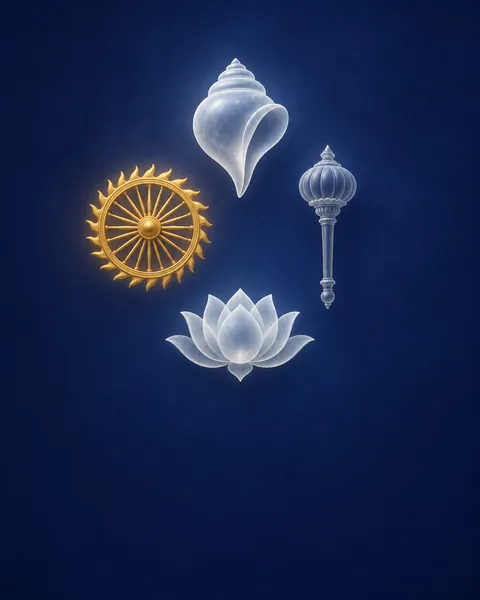
- conch, discus, mace
- Vāhana
- Garuḍa
- Colour
- white
- Holds, wears
- white garment, white lotus seat
स्थान
- मणिद्वीप (श्रीपुर)Maṇidvīpa
The Goddess's own realm, the 'jewel island', set above all other worlds in Śākta texts.
- शक्तिपीठाःŚakti pīṭhas
Seats of the Goddess, where parts of Satī's body are said to have fallen; lists give 4, 18, 51 or 108.
Abodes, with their source 1
- Śrīnagara on Meru, in the Cintāmaṇi house (Maṇidvīpa in the Devī Bhāgavata)abode of Lalitā Tripurasundarī
- Lalita Sahasranama verse 73
- Devī Bhāgavata Purāṇa 12.10–12 (Maṇidvīpa-varṇana) unverified
त्योहार
The days these texts are said on, from Pramāṇa's own text records.
स्रोत क्या कहते हैं
4 sourced facts from 2 sources, each with the matched quote.
शब्दकोश में 1
devī: a female deity, goddess; e.g. Durgā, the wife of Śiva.
a female deity, goddess
Monier-Williams Sanskrit-English Dictionary (1899), Cologne Digital Sanskrit Dictionaries
MW p.496 col.1प्रोग्राम ने जाँचा
Open sourceवाहन 1
Siṃha (lion)
himavān vāhanaṃ siṃhaṃ ratnāni vividhāni ca
Mārkaṇḍeya Purāṇa (Devī Māhātmya), GRETIL
MkP 82.29 (Devīmāhātmya 2.29)प्रोग्राम ने जाँचा
Open sourceविशेषण 1
The gods hail her as Siṃhavāhinī, 'she who rides the lion'.
jayeti devāśca mudā tāmūcuḥ siṃhavāhinīm
Mārkaṇḍeya Purāṇa (Devī Māhātmya), GRETIL
MkP 82.34 (Devīmāhātmya 2.34)प्रोग्राम ने जाँचा
Open sourceप्राचीन ग्रन्थों में 1
Devīmāhātmya ch. 3: the Goddess cuts off Mahiṣāsura's head with her great sword.
tayā mahāsinā devyā śiraśchittvā nipātitaḥ
Mārkaṇḍeya Purāṇa (Devī Māhātmya), GRETIL
MkP 83.40 (Devīmāhātmya 3.40)प्रोग्राम ने जाँचा
Open source